
Role
SITEREA defines the source boundaries, generation workflow, validation gates and release discipline shown here.
PayloadSystems
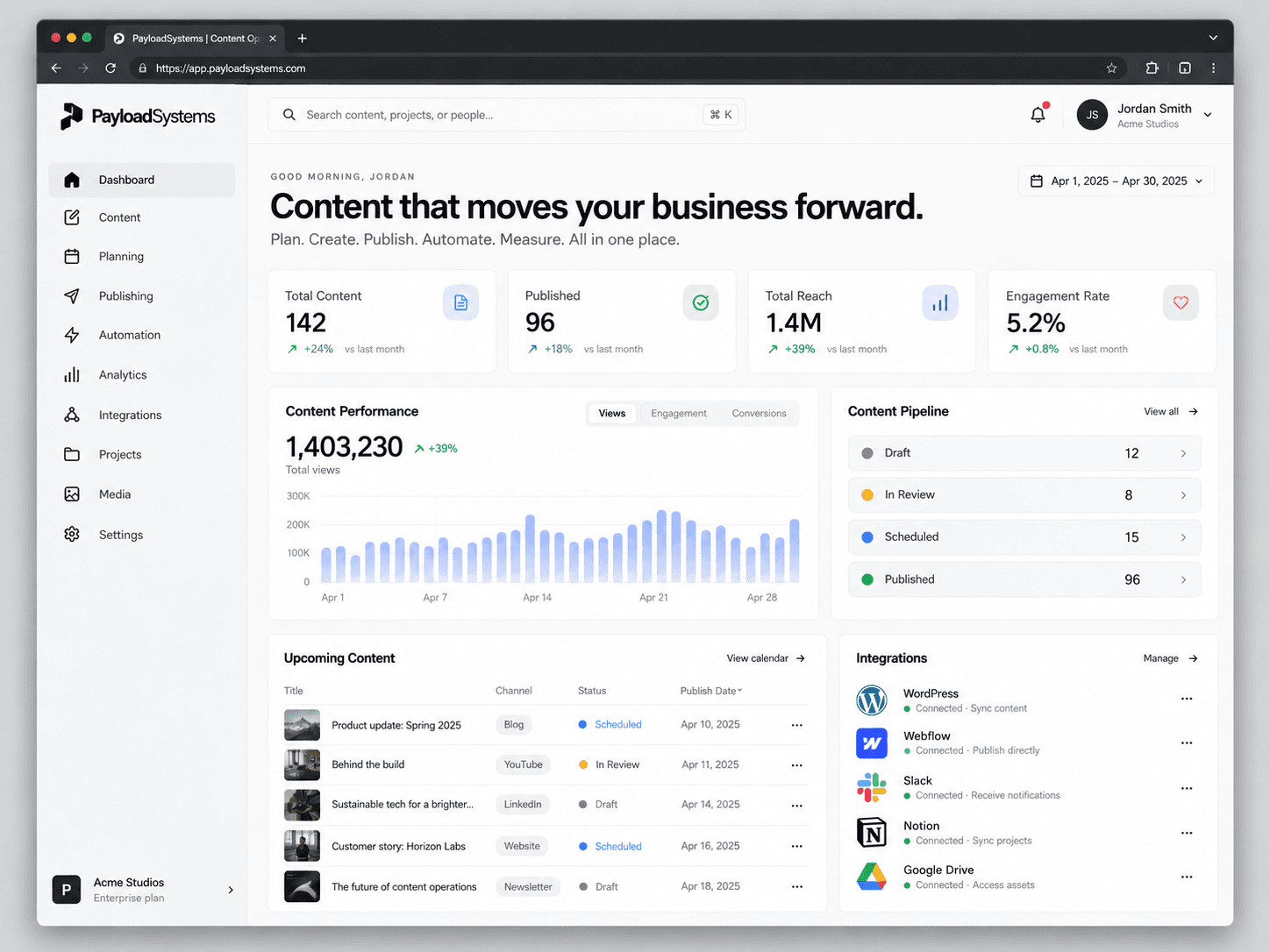
PayloadSystems is a SITEREA-owned automation case built around controlled sources, durable execution, validation and release gating. The useful lesson is that speed and autonomy still need explicit authority, evidence and recovery.
Release pipeline
Case status
The page documents an owned automation architecture and its release controls rather than claiming that generated output is trustworthy by default.
Role
SITEREA defines the source boundaries, generation workflow, validation gates and release discipline shown here.
System principle
Generated output remains a candidate until required checks and approvals have completed.
Recovery principle
A release must have a known identity and a recovery path; automation cannot self-certify merely because execution completed.
Candidate-to-release
Every stage answers a different question: where did it come from, is it valid, who may approve it, and how can it be recovered?
Only approved input or bounded project context enters the generation task.
The model creates a draft, plan or change proposal without publication authority.
Static checks, tests and project-specific gates evaluate correctness and regressions.
The authorized release path applies only validated content or code.
If the release fails, the system can restore or roll back from a known prior state.
Release authority
A model or agent can prepare candidates and run bounded tasks; release still depends on explicit gates and a recoverable production path.
Source material must be approved or bounded before generation.
A successful generation call is not a successful release.
Validation output must stay attached to the candidate it evaluated.
Rollback or restoration must reference a known prior state.
Failure mode
The correct behavior is to stop the release—not to ask the model to declare itself correct.
The failed artifact remains inspectable with its source and validation output.
Release authority stays closed until the failing condition is resolved.
A new candidate or targeted fix runs through the same gates before release.
Exception / boundary
A completed agent run is not equivalent to a validated release.
What this proves
The pipeline makes autonomy compatible with accountable production change.
Case next step
Use the PayloadSystems case to separate generation, validation, approval, release and recovery in your own workflow.