Strategic Design
Education Platforms: Design Patterns for Trial Course Completion to Paid Upgrade

This article examines design patterns for transitioning users from trial course completion to paid upgrades in education platforms.
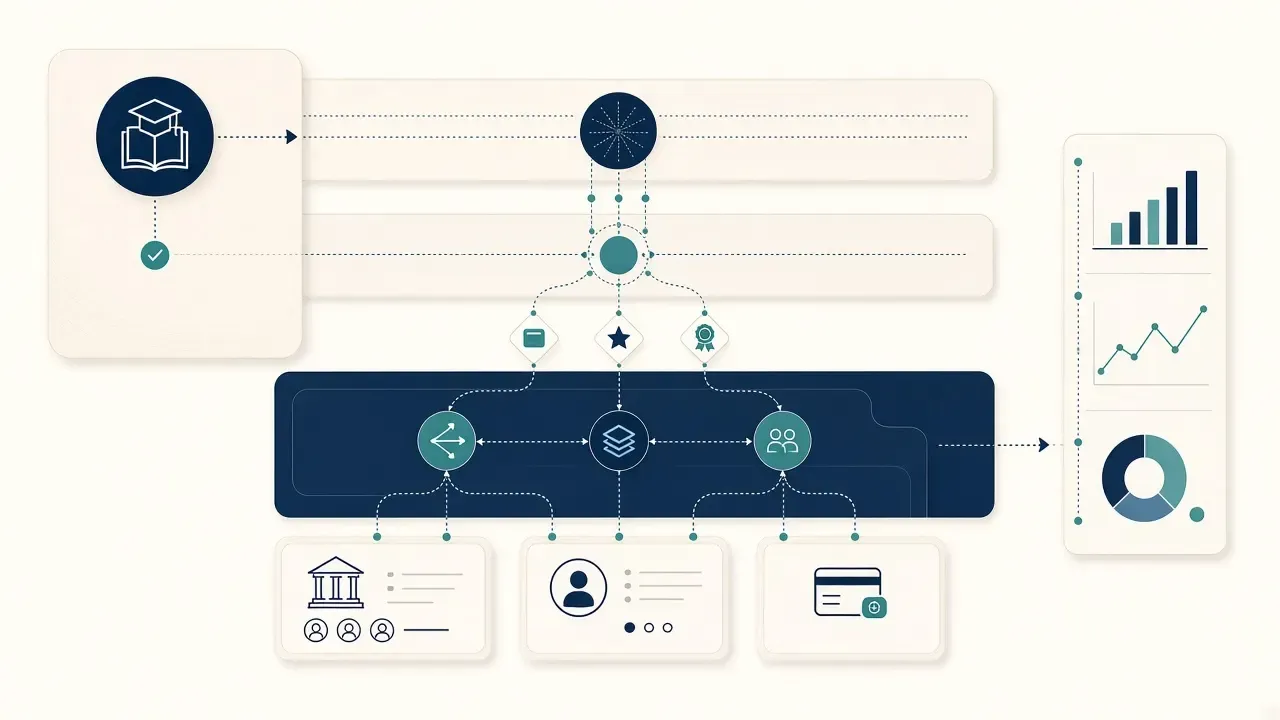
The moment a learner finishes the final module of a trial course, the platform must align prior activity, current access state, and next-step presentation before the learner disengages. Misalignment turns completion into an endpoint rather than a handoff.
Post-Completion Sequence Patterns
Three patterns manage the immediate transition. The first keeps the learner inside the course shell and appends a continuation panel that shows the next module behind an access flag. Implementation uses course metadata already loaded for the trial plus a boolean check against the learner’s entitlement record. The panel renders server-side when payload size matters or hydrates client-side when subsequent interactivity takes priority.
Server-side rendering avoids an extra client round-trip but requires the entitlement service to be queried during the same request that serves the final module view. Client-side hydration allows the panel to update if the entitlement record changes mid-session, yet it introduces a brief window where the learner sees the flag before the boolean resolves. A failure mode occurs when the entitlement service returns an error; the panel must then default to a locked state rather than expose paid content.
A second pattern exits the course view and surfaces a progress dashboard. This aggregates completed modules, remaining trial content, and paid extensions in one list. It requires reliable cross-session progress storage and a boundary marker that separates trial modules from paid modules. The dashboard reduces the chance an upsell appears while the learner still expects trial material, but it inserts a navigation step whose completion rate must be measured separately from the upgrade decision.
Storage can rely on event logs written at each module boundary or on a materialized view that recomputes on demand; the choice affects whether the dashboard reflects the most recent completion instantly or after a short aggregation delay. Event-log storage preserves every module boundary timestamp but demands that the query layer can reconstruct the boundary marker without scanning the full history. Materialized views shift the cost to write time and can become stale if the recomputation job falls behind during peak completion traffic.
A third approach generates a short recap from quiz responses or exercise artifacts, then presents one recommended continuation path. This needs either pre-authored recap templates tied to module identifiers or an on-demand generation step that pulls from stored learner data. When a course model stores only completion flags rather than response artifacts, the pattern falls back to a generic summary.
On-demand generation adds a dependency on the artifact store remaining available at completion time; if that store is partitioned separately from the course catalog, latency or partial failure can leave the recap incomplete. Pre-authored templates avoid the runtime dependency but require authors to maintain a template for every module that might serve as a trial endpoint. Diagnostic questions here include whether the artifact store partition shares the same availability SLA as the course catalog and whether template maintenance is tracked in the same content workflow as module updates.
Trial length affects which pattern fits. A short trial that already covered core material can use an immediate continuation panel. A longer trial that delivered substantial content before the final module benefits from dashboard separation so the learner can review completed work before facing payment. Applying one pattern across all trial depths removes the ability to match prompt intensity to material already consumed. The decision can be driven by a simple threshold on total modules or by a more granular check against the fraction of course content delivered during the trial window. The threshold approach is simpler to implement yet ignores variation in how densely the trial window covered foundational versus advanced material.
| Pattern | Data Dependencies | Latency Risk | Trial-Length Fit |
|---|---|---|---|
| Continuation panel | Course metadata + entitlement boolean | Low if server-side; brief window if client-side | Short trials with core material already shown |
| Progress dashboard | Cross-session progress + boundary marker | Aggregation delay on materialized views | Longer trials with substantial prior content |
| Recap + recommendation | Quiz/exercise artifacts or pre-authored templates | Store partition failure or generation step | Any length when response data exists |
Observable Signals at Completion
At module completion the system records several signals without further learner input. Completion timestamp relative to enrollment date distinguishes steady pacing from single-session bursts. Quiz or exercise scores supply a proxy for competence gained, though proxy strength varies by assessment design. Session count and cumulative time spent provide a coarse engagement depth measure. These values combine into a qualification score that selects among offer variants.
The score calculation itself can be a weighted sum or a decision tree; either form must be versioned so that changes to the weighting can be rolled back without altering historical offer decisions. Versioning also supports A/B tests that hold the underlying signals constant while varying only the aggregation rule.
High time-on-task combined with strong quiz performance can route the learner toward an advanced track or certification bundle. Lower engagement metrics can surface a lower-priced option that includes review access or extended trial time. The score functions as a hypothesis generator rather than a confirmed intent signal. A learner who completed material quickly may have done so because prior knowledge aligned with the content. A learner who spread sessions across weeks may face scheduling constraints rather than declining motivation. Without an explicit preference capture step, the platform must treat the score as one input among several.
Diagnostic practice centers on logging which signals contributed to each offer variant and tracking whether subsequent conversion differed across segments. If the qualification score shows no consistent relationship with upgrade rates across repeated tests, the weighting can be adjusted or the score removed from the decision path. The same logging also reveals whether certain course topics produce systematically different signal distributions, allowing content-specific adjustments without assuming a universal model.
Edge cases appear when a learner resets progress or when an account merges two prior identities; both events can distort the timestamp and session-count signals unless the merge logic explicitly reconciles them. Reconciliation must align the completion timestamp from the earlier identity, the cumulative session count across both records, quiz response artifacts if stored separately, progress flags written under the secondary account identifier, and any enrollment-date reference that determines trial eligibility windows. A measurement design question is whether merge events are logged with enough metadata to reconstruct the pre-merge signal state for later analysis.
Upgrade Path Architectures
Once the learner reaches the payment decision, the flow can be structured as a single-page choice, a multi-step configurator, or a consultation handoff. The single-page choice displays two or three priced options with feature differences and a direct payment action. It requires stable pricing and entitlement data but minimal additional system calls. The assumption is that the learner already understands how paid content maps to their goals; when that assumption fails, conversion drops even if the page loads without error.
The multi-step configurator collects duration, format, or add-on preferences before surfacing price. It surfaces more granular needs and can prevent later support contacts about mismatched expectations. The added steps increase abandonment risk for learners who simply want continued access to the same format they just finished. The configurator also requires a product catalog that can be filtered by learner attributes without exposing unavailable combinations, which adds catalog maintenance overhead.
In contrast to the single-page choice, the configurator lowers expectation mismatch risk by surfacing preference questions before price is shown, yet it lengthens the path for learners whose needs already match the default continuation. A trade-off appears in catalog design: exposing every valid combination upfront reduces runtime filtering cost but increases the surface area that must stay synchronized with pricing changes.
The consultation path replaces immediate purchase with a calendar booking or form submission. It suits higher-priced programs that involve organizational approval or custom pacing. The path converts the upgrade moment into a separate workflow that must itself be instrumented for completion rate, lead aging, and downstream conversion. Support-volume tracking for the consultation path records the frequency and nature of follow-up inquiries that arise after the initial booking, providing a signal for whether the handoff process itself introduces friction. Without tight handoff processes, the consultation request cools before follow-up occurs.
Each architecture therefore carries a distinct instrumentation requirement: the single-page choice needs only payment success events, while the configurator and consultation paths require intermediate step completion events to isolate where drop-off occurs. A practical comparison test presents the same offer set through each architecture on equivalent traffic segments. The test should track not only immediate conversion but also refund rates and support volume in the first thirty days after purchase, since a rushed decision can produce later dissatisfaction even when the initial click succeeded. The test design must hold offer content constant so that differences can be attributed to flow structure rather than to differences in what is being offered.
Cross-System Consistency and Measurement
The Education Platforms: Design Systems for Course Enrollment already defines how a learner moves from discovery to trial start. The upgrade decision rarely occurs in isolation. An active referral credit, an unfinished enrollment in another trial course, or prior purchase history can alter the appropriate offer or flow. Maintaining consistency requires a shared decision layer that receives signals from course completion, account history, and current promotions. Without that layer, separate teams can introduce conflicting offers that confuse learners or undermine pricing integrity.
The post-completion sequence must reuse the same content metadata and access rules so that paid continuation registers as a direct extension rather than a restart. Divergence in how the two systems represent course structure or prerequisites creates friction at the moment payment is requested.
Relevant metrics begin with the share of trial completers who reach the upgrade screen. Low reach rates point first to the post-completion sequence itself. The distribution of time between completion and upgrade view provides a second signal; long gaps suggest the prompt was not prominent or the learner left the platform before the screen rendered. Conversion from upgrade view to payment should be segmented by the signals recorded at completion. Material differences in conversion by quiz score or time-on-task indicate that offer selection logic may need refinement. Differences that appear only within specific course topics suggest content-specific rather than platform-wide adjustments.
Downstream indicators include the share of paid courses started within a defined window after upgrade and the completion rate of the first paid module. These separate upgrades that produce continued activity from upgrades that function mainly as insurance against lost access. When view rate, payment conversion, and subsequent activity move together, the post-completion sequence can be treated as a coherent system. When they diverge, diagnosis requires separating prompt design from offer content from payment mechanics.
A concrete diagnostic step is to map every field used in the upgrade decision back to its source system and confirm that changes in course metadata propagate without manual intervention. When propagation lags, the upgrade prompt can reference modules or pricing that no longer match the catalog. The same mapping also identifies which additional account-level signals can be incorporated without introducing new data dependencies. An additional observable failure mode appears when the shared decision layer receives stale promotion data from the referral system; the resulting offer then displays a credit the learner no longer holds, which surfaces as an error only after the learner reaches the payment form.