
Strategic Design
Home Services Marketplaces: Retention Design Patterns After Initial Booking Completion

This article examines retention design patterns implemented by home services marketplaces after an initial booking is completed.
Once a booking reaches confirmed status, the platform loses direct control over the service encounter yet remains accountable for whether the customer initiates a second transaction. Booking logs frequently show platforms surfacing only status updates until completion, with support patterns indicating limited structured re-engagement prompts in the interim. The interval between confirmation and the next purchase decision contains the mechanics that determine repeat use.
State Transitions and Visibility After Confirmation
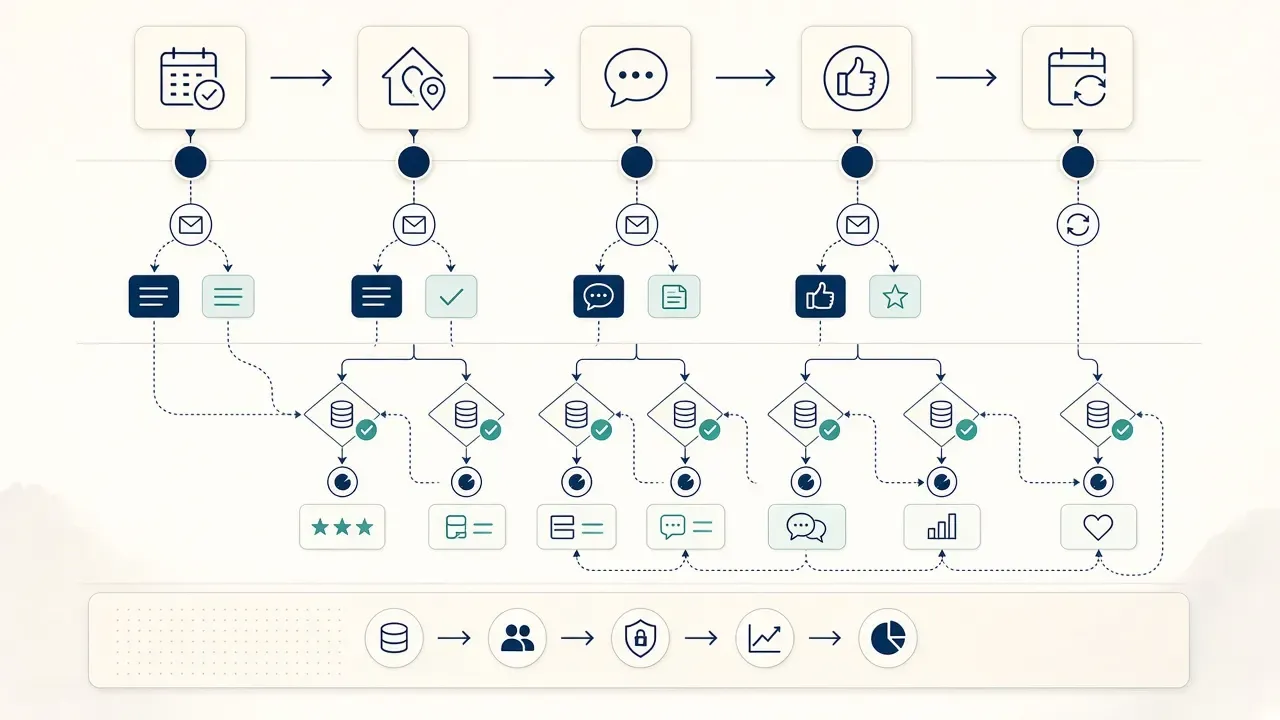
The initial design decision concerns which signals the platform exposes between confirmation and completion. Minimal models surface only confirmed, in progress, and completed. Richer models add dispatch, arrival window refinement, parts procurement, on-site assessment, and post-service verification. Each added state depends on provider-side data feeds. When those feeds are absent, the platform must either poll external calendars or rely on manual provider updates, both of which introduce latency and error.
Operational cost rises with each additional state because mismatched reports generate support volume. Sparse state data, however, leaves customers without a predictable next action from the platform. A practical diagnostic segments support tickets by the timestamp of the most recent visible state change. Clusters appearing more than 24 hours after the last displayed update flag cohorts for which the state model has gone stale. This segmentation runs against existing booking logs.
The post-confirmation flow should preserve context accumulated during the lead stage. Linking the two experiences prevents the customer from re-entering property details or service history that the platform already holds. The existing analysis of lead architecture for booking confirmation rates describes the pre-booking data that can be carried forward without duplication.
Implementation of richer state models requires a decision on data ingestion frequency. Polling external calendars at fixed intervals creates predictable load but can miss short-notice changes such as provider cancellations. Event-driven webhooks reduce latency when providers support them, yet they introduce dependency on third-party uptime and schema stability. A hybrid approach maintains a last-known state with an explicit staleness threshold; once the threshold is crossed, the platform surfaces a manual confirmation request to the provider rather than displaying potentially incorrect information to the customer.
Trade-offs appear in support routing as well. When state granularity increases, support agents gain more precise context for triage, but the volume of status-update tickets can rise if customers interpret every intermediate state as an actionable event. Logging the exact state at the moment a ticket is opened allows later analysis of whether finer-grained visibility correlates with higher or lower ticket rates per booking. The same logs can be joined to rebooking timestamps to test whether added states alter the distribution of time-to-second-transaction.
Data freshness rules must also account for service duration. Short jobs such as drain cleaning produce state changes within hours, while multi-day projects such as roof replacement generate longer gaps between updates. A uniform staleness threshold applied across categories therefore creates false alerts on one side and silent failures on the other. Segmenting the threshold by average job length, derived from historical completion timestamps, reduces both types of error.
Structured Follow-Up Sequences Versus Ad-Hoc Outreach
After completion the platform chooses between a controlled message sequence and provider-managed contact. A controlled sequence can include a same-day receipt, a 48-hour outcome check, a maintenance tip at seven days, and a rebooking prompt at 30 days. Each message occupies notification real estate; excess volume depresses open rates across the program. Provider-managed follow-up keeps the direct relationship intact but removes the platform’s ability to insert its own rebooking prompt or capture structured feedback.
When the platform owns the sequence, each message requires distinct attribution tokens so analytics can tie rebooking events to specific touchpoints. When the provider owns follow-up, the platform can mandate an API callback or simple form that records whether any post-service message was sent. Absence of that signal becomes an early indicator for accounts that may require intervention.
The choice also affects data ownership. Platform-controlled sequences generate first-party signals on message performance. Provider-controlled sequences shift that data outside the platform, limiting the ability to test prompt variants or timing adjustments at scale. A middle path records only the fact of a provider-sent message without its content, preserving some measurement capability while respecting relationship boundaries.
Implementation detail matters for sequence ownership. Attribution tokens must survive across channels; a token embedded in an email link must still resolve correctly if the customer later opens the app. Token collision risk increases when multiple sequences run in parallel for different service categories, requiring namespace separation in the analytics schema. For provider-managed flows, the callback endpoint needs rate limiting and validation rules to prevent fabricated signals from low-quality accounts.
Sequence cadence itself introduces another variable. Fixed calendar intervals ignore variation in service half-life; a water-heater replacement may not generate repeat demand for years, while gutter cleaning repeats seasonally. Replacing fixed intervals with usage-cycle calculations derived from property metadata and climate data reduces irrelevant messages but requires the same property coverage that later affects prompt effectiveness.
Feedback Capture Timing and Format
Review requests placed immediately after completion record the emotional residue of the encounter rather than durability of the outcome. Requests placed several days later allow assessment of whether a repair held or a cleaning endured, yet they also permit memory decay. The interval therefore operates as a tunable parameter whose value depends on service category.
Format choices interact with timing. A single star rating yields volume but supplies little diagnostic information. A multi-question form raises abandonment. An in-app prompt that appears only after the customer opens the booking detail page filters for users already returning to the platform, which reduces noise at the cost of lower total responses.
The relevant measurement question is whether the feedback instrument itself predicts second bookings better than completion status alone. A cohort comparison that holds provider and service type constant can isolate the instrument’s contribution from selection effects. When the comparison shows no difference in rebooking rates, the platform can reduce form length or shift the request window without measurable loss.
Additional format options include voice notes or photo uploads for visual services such as landscaping or painting. These increase response richness but require storage and moderation pipelines. The decision to enable richer formats should be gated on whether the added data improves downstream prediction of repeat bookings or merely increases operational overhead. A simple test joins feedback format flags to second-booking events within a fixed window and measures lift after controlling for provider fixed effects.
Diagnostic queries against booking logs can surface whether feedback submitted inside a narrow post-completion window produces different distributions of subsequent search events than feedback submitted after a longer delay. The query joins the feedback submission timestamp to the first observed re-engagement signal while holding service category and provider constant. When the resulting interval distributions show no material separation, the platform can move the capture window toward lower operational cost or higher response durability without altering the leading indicator used for retention tracking.
Pathways to the Second Booking
Retention resolves to whether the customer starts another search or receives a prompt that reduces friction for the next transaction. Prompts can be constructed as pre-filled service requests drawn from the first booking, seasonal reminders calculated from property and climate data, or bundled offers that pair the original service with an adjacent one. Each construction imposes different data requirements. Pre-filled requests need stored property attributes. Seasonal reminders need date arithmetic against usage cycles. Bundles need a catalog model that defines adjacency and validates common pairings.
Pre-filled requests carry the risk of assuming the customer wants the identical service again, an assumption that fails for one-time repairs. Seasonal reminders avoid that assumption but require location and property metadata that many marketplaces maintain only at partial coverage. Bundles raise average order value on the second transaction yet add choice complexity that can depress conversion when pairings are not pre-validated.
A direct test compares second-booking rates when the prompt is shown only to customers whose first service type has a documented repeat interval in booking history against rates when the prompt is shown to all customers. The difference isolates the contribution of historical frequency data versus generic prompting.
Data model choices further constrain prompt design. Property attributes must be versioned so that a change in ownership or square footage does not silently invalidate a pre-filled request. Adjacency rules for bundles require maintenance; an initially valid pairing can become obsolete when a provider stops offering one of the services. Seasonal calculations depend on reliable climate or usage data sources, and gaps in coverage create cohorts that never receive the reminder.
Versioning also affects auditability. When a prompt fires based on an outdated property record, the resulting booking may be misattributed to the prompt rather than to independent customer intent. Storing the exact attribute snapshot used at prompt generation allows later reconciliation of false positives.
Versioning edge cases arise when ownership transfers, square footage changes after renovation, or data corrections are applied retroactively to earlier bookings. Booking logs can be queried for instances where the attribute snapshot at prompt generation differs from the snapshot at the subsequent booking confirmation. The query flags records where the mismatch coincides with a change in the second-booking path, enabling the platform to decide whether to tighten snapshot retention rules or to add an explicit confirmation step before the prompt is rendered.
Measurement Framework That Avoids Vanity Metrics
Retention programs often default to tracking message open rates or review submission volume. These metrics register activity without confirming whether activity produced another booking. A tighter framework follows three sequential signals: re-engagement with any booking detail page within a defined window, execution of a second search query, and confirmation of a second booking. Only the final signal counts as retained revenue; the earlier signals function as leading indicators that can be inspected when final conversion stalls.
Cohort construction must control for provider quality and service category because repeat rates differ by service category, which requires cohort controls. Without that control, platform-level retention figures mix changes in service mix with changes in design effectiveness.
When second-booking rates remain flat after a new retention feature ships, the next diagnostic examines the distribution of time-to-second-booking. A shift toward longer intervals without volume growth indicates the feature delayed rather than expanded demand. Compression of the interval distribution without volume growth indicates the feature captured existing intent earlier but did not enlarge the total repeat base. These distinctions determine whether the next iteration should broaden eligibility, adjust timing, or improve the data quality that feeds the prompts.
The measurement distinctions also surface when a feature appears to succeed on one service category yet produces no movement on another. In such cases the platform can inspect whether the feature’s data inputs—property attributes, repeat intervals, or adjacency rules—exist at comparable completeness across categories. Inspection proceeds by calculating coverage percentages for each required field within each category’s recent bookings, then comparing those percentages against the categories that showed movement. When coverage falls below 70 percent for any required field, data-completion work precedes further prompt iteration. Where inputs are incomplete, the feature cannot be expected to perform uniformly, and the priority becomes data completion rather than prompt redesign. This diagnostic loop keeps iteration focused on observable conditions instead of assumed user behavior.
Related articles
Home Services Marketplaces: Lead Architecture for Booking Confirmation Rates